
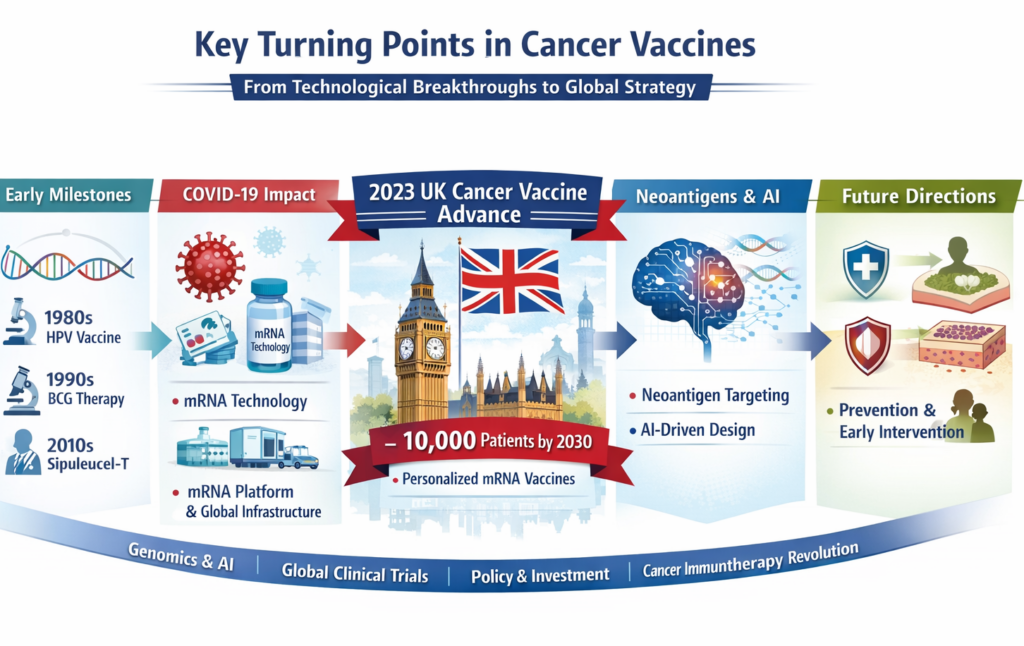
Key Turning Points in Cancer Vaccines: Rethinking the Global Strategy from Technological Breakthroughs to Strategic Implementation
A Review and Commentary on the Emerging Era of Cancer Vaccines
Abstract
In recent years, rapid advances in vaccine technology and tumor immunology have brought cancer vaccines back into the global spotlight. The United Kingdom’s Cancer Vaccine Advance program, launched in 2023, aims to provide personalized mRNA cancer vaccines to 10,000 patients by 2030, marking a critical milestone in transitioning cancer vaccines from proof-of-concept to large-scale clinical application. This review summarizes the development history of cancer vaccines, recent technological breakthroughs, and clinical evidence, while analyzing how artificial intelligence (AI), genomics, and vaccine platform technologies are reshaping cancer immunotherapy. Furthermore, the review incorporates global policy and research investment trends to discuss the strategic significance of cancer vaccines in future public health and precision medicine.
I. Cancer Vaccines: From Concept to Clinical Turning Points
Vaccines have long been regarded as a public health tool for preventing infectious diseases by priming the immune system to defend against pathogens before infection occurs. Cancer vaccines, however, differ in both design and purpose. They aim not only to prevent cancer but also to serve as therapeutic tools that enable the immune system to recognize and eliminate tumor cells.
Cancer vaccines can generally be classified into two categories:
- Preventive vaccines
- Therapeutic vaccines
Currently, preventive vaccines remain the most clinically impactful, with notable examples including:
- Hepatitis B vaccines (preventing liver cancer)
- Human papillomavirus (HPV) vaccines (preventing cervical cancer)
By contrast, therapeutic cancer vaccines have developed more slowly. To date, only three have gained regulatory approval:
- BCG (Bacillus Calmette–Guérin) for bladder cancer
- Talimogene laherparepvec for melanoma
- Sipuleucel-T for prostate cancer
While these vaccines demonstrate the feasibility of immunotherapy, their clinical use remains limited.
II. COVID-19 Pandemic: An Unexpected Catalyst for Cancer Vaccine Development
Since 2020, the success of COVID-19 vaccines has transformed the trajectory of global vaccine technology. The rapid development and large-scale production of mRNA vaccines dramatically shortened the vaccine development cycle, which previously took decades.
Key infrastructures established during the pandemic include:
- mRNA vaccine manufacturing technologies
- Global cold-chain logistics
- Real-time genomic surveillance
- Large-scale clinical trial platforms
- Cross-national government–industry collaboration models
After the pandemic, these infrastructures were quickly repurposed for other medical research fields, most notably cancer vaccines.
The UK’s 2023 Cancer Vaccine Advance program is a representative example. By integrating government, academic, and industry resources and conducting large-scale clinical trials across multiple tumor types, this program aims to evaluate the safety and efficacy of personalized mRNA cancer vaccines.
This national-level strategy demonstrates that cancer vaccines are no longer merely an academic research topic but have become a key indicator of national healthcare and biotech competitiveness.
III. Technological Breakthroughs: Personalized Cancer Vaccines and the Neoantigen Revolution
The most significant breakthrough in cancer vaccine research has come from neoantigen vaccines.
Tumor cells acquire genetic mutations that produce tumor-specific protein variants—neoantigens—that are absent in normal tissues, making them ideal immunotherapy targets.
Through next-generation sequencing (NGS) and bioinformatic analysis, researchers can:
- Characterize the mutational landscape of a patient’s tumor
- Predict immunogenic antigens
- Design personalized vaccines
The mRNA vaccine platform provides the speed and flexibility required for personalized manufacturing.
In a phase 2 clinical trial, the personalized mRNA neoantigen vaccine mRNA-4157, combined with the immune checkpoint inhibitor pembrolizumab, showed a substantial reduction in recurrence in melanoma patients, with a recurrence-free survival rate of 79%, demonstrating the clinical potential of personalized vaccines.
Another approach involves shared antigen vaccines, which target common tumor-driving genes such as HER2 (ERBB2), and have demonstrated long-term immune responses in multiple clinical trials.
IV. Artificial Intelligence and Cancer Vaccine Design
One of the greatest challenges in cancer vaccine development is antigen selection. Tumors are highly heterogeneous, and many are immunologically “cold”, meaning their microenvironments lack immune cell infiltration, particularly T cells, limiting effective immune responses.
Artificial intelligence and high-performance computing are transforming this landscape. By training generative AI models, researchers can predict the most immunogenic antigen combinations and design multi-antigen vaccines.
The UK’s Cancer Vaccines AI & Supercompute Project trains AI models on real tumor datasets to accelerate antigen discovery and vaccine design. These technologies have the potential to shorten development timelines and improve treatment precision.
V. Global Scientific Competition and Policy Implications
From a global perspective, the United States remains a leader in cancer vaccine research, producing approximately half of all related publications. However, recent reductions in US funding for vaccine and related technology research may hinder future innovation.
In contrast, Europe and the UK are actively repurposing biotechnology infrastructure developed during the pandemic for cancer research and accelerating clinical translation through national-level programs.
The cancer vaccine market is also experiencing rapid growth:
- 2023: approximately $10.12 billion
- 2032 (projected): approximately $42.58 billion
This trend indicates that cancer vaccines are not only a medical breakthrough but also an emerging arena of global biopharmaceutical competition.
VI. Future Directions: From Treatment to Prevention
Cancer vaccine strategies are undergoing a major shift. Historically focused on treating advanced tumors, emerging research suggests that vaccination during minimal residual disease (MRD) stages may be more effective in preventing recurrence.
Future applications may include:
- Postoperative recurrence prevention
- Immunoprevention of premalignant lesions
- Preventive vaccines for high-risk populations
This approach will increasingly integrate cancer vaccines into public health and preventive medicine frameworks.
Conclusion
The development of cancer vaccines has undergone decades of exploration, with early results limited. However, advances in mRNA technology, genomics, and artificial intelligence mark a critical turning point. The UK’s Cancer Vaccine Advance program and multiple global clinical trials indicate that cancer vaccines are transitioning from conceptual research to practical clinical application.
In the context of rising cancer incidence worldwide, cancer vaccines not only have the potential to transform tumor treatment paradigms but also to serve as a key tool in cancer prevention and public health. Continued investment in research, integration of AI, and application of precision medicine technologies may enable cancer vaccines to become the next major breakthrough in medical history.
Reference: The Time for Cancer Vaccines Is Now Advancing Toward Lasting Cancer Immunity
中文版: 癌症疫苗的關鍵轉折點:從技術突破到全球戰略的再思考
Reviewer: PI-Union Medical Science Ltd.
- E-mail: piunion@pi-union.com
- Official Website: https://pi-union.com/
- Facebook: www.facebook.com/piunion2020
- Youtube: www.youtube.com/@pi-union
- Instagram: www.instagram.com/piunion2020
- LINE: @654eukag