
AI Chatbot Use and Disclosure for Mental Health Among US Adolescents and Young Adults
Ryan K. McBain et al.
JAMA Pediatrics. 2026 Aug 1;180(8):884–890.
Summarized by PI-Union Medical Science Ltd.
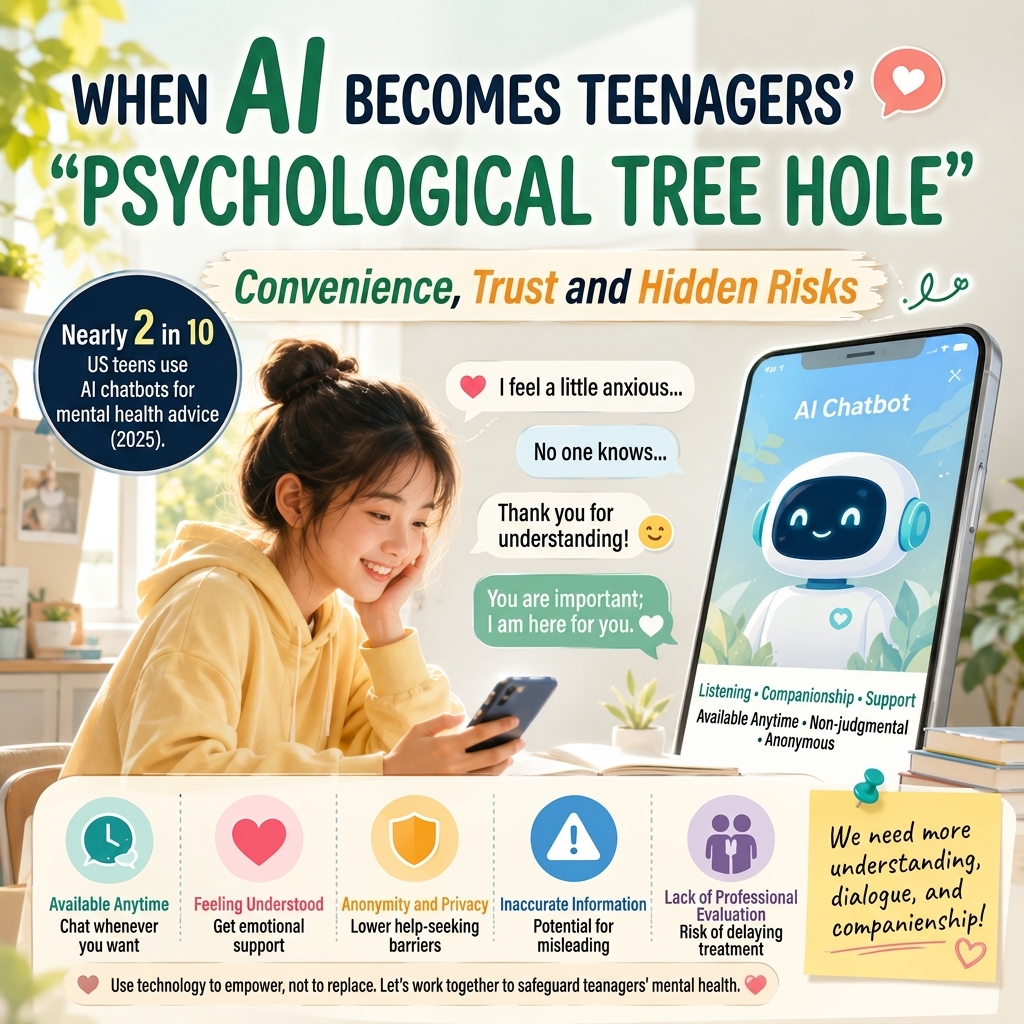
The rapid adoption of artificial intelligence (AI) chatbots is occurring alongside the ongoing mental health challenges faced by adolescents and young adults. This study examined the prevalence, frequency, perceived helpfulness, and disclosure of AI chatbot use for mental health advice among US individuals aged 12 to 21 years. A nationally representative cross-sectional survey was conducted in November 2025. Among 1,009 participants representing 42,825,655 individuals after population weighting, 19.2% (8,207,180) reported using AI chatbots to seek mental health advice. Among users, 42.8% used AI chatbots at least monthly, and 91.7% considered the advice somewhat or very helpful. However, 63.3% had not disclosed their AI use to anyone. AI chatbot use was more common among females than males (aOR, 2.10; 95% CI, 1.36–3.23), those aged 18–21 years versus 12–14 years (aOR, 3.65; 95% CI, 1.98–6.74), and those who had discussed mental health concerns with a physician in the previous 6 months (aOR, 1.89; 95% CI, 1.18–3.03). These findings suggest that AI chatbots have rapidly become part of the mental health information ecosystem for young people. Although many users perceive AI advice as helpful, the high proportion who do not disclose their use highlights an emerging hidden mental health care pathway. Parents, clinicians, and policymakers should proactively address AI chatbot use and promote safe use, appropriate expectations, and connections to evidence-based mental health care.
Commentary by PI-Union Medical Science Ltd.
1. AI Is Becoming a New “Confidant” for Adolescents
In 2025, 19.2% of US adolescents and young adults aged 12–21 years had used AI chatbots to seek mental health advice, representing approximately 8.2 million people. Among users, 42.8% used AI at least monthly, and 91.7% considered the advice somewhat or very helpful.
These findings suggest that AI offers young people a low-barrier, readily accessible, and relatively private space for emotional disclosure. For adolescents who may hesitate to approach parents, teachers, or health professionals, AI could become an important first point of contact for mental health concerns.
2. The Hidden Mental Health Care Pathway
The most concerning finding is that 63.3% of users had not disclosed their AI use to anyone.
This raises a critical question:
Is AI becoming a bridge to professional mental health care—or an endpoint that may bypass it?
AI could facilitate help-seeking if it encourages users to contact parents, clinicians, or other trusted adults. However, if young people rely exclusively on AI without professional assessment, it may create a hidden mental health care pathway that operates largely outside the awareness of families, schools, and health professionals.
Notably, participants who had discussed mental health concerns with a physician in the previous 6 months were more likely to use AI for mental health advice (aOR, 1.89). This may suggest that AI is being used alongside, rather than necessarily instead of, conventional mental health services. However, the cross-sectional design prevents causal interpretation.
3. Perceived Helpfulness ≠ Clinical Effectiveness ≠ Safety
Although 91.7% of users perceived AI advice as helpful, subjective helpfulness should not be equated with clinical effectiveness or safety.
AI may provide useful emotional support or general coping strategies, but its ability to recognize and appropriately respond to suicidal ideation, self-harm, eating disorders, psychosis, severe anxiety, or other high-risk conditions remains a critical concern.
The key distinction is:
AI is already being used—not that AI has already been proven effective.
4. Important Research Gaps
Several limitations warrant consideration. First, the cross-sectional design prevents conclusions about causality. Second, reliance on self-reported data introduces potential recall and reporting biases. Third, the study did not evaluate the content or clinical quality of AI-generated advice.
Future research should therefore examine whether AI responses are consistent with clinical guidelines, how accurately they identify high-risk situations, whether they appropriately recommend professional care, and whether safety varies across AI models.
5. Public Health Implications
The central public health question is no longer simply whether adolescents use AI, but:
When young people turn to AI for mental health support, who knows, who is responsible, and who protects them?
Mental health policy must increasingly consider AI alongside families, schools, clinicians, and public health systems. AI may become an important entry point into mental health care—but its role should be designed to complement, rather than silently replace, evidence-based professional care.
Reference: AI Chatbot Use and Disclosure for Mental Health Among US Adolescents and Young Adults
Reviewer: PI-Union Medical Science Ltd.
* E-mail: piunion@pi-union.com
* Official Website: https://pi-union.com/
* Facebook: www.facebook.com/piunion2020
* Youtube: www.youtube.com/@pi-union
* Instagram: www.instagram.com/piunion2020
* LINE: @654eukag