
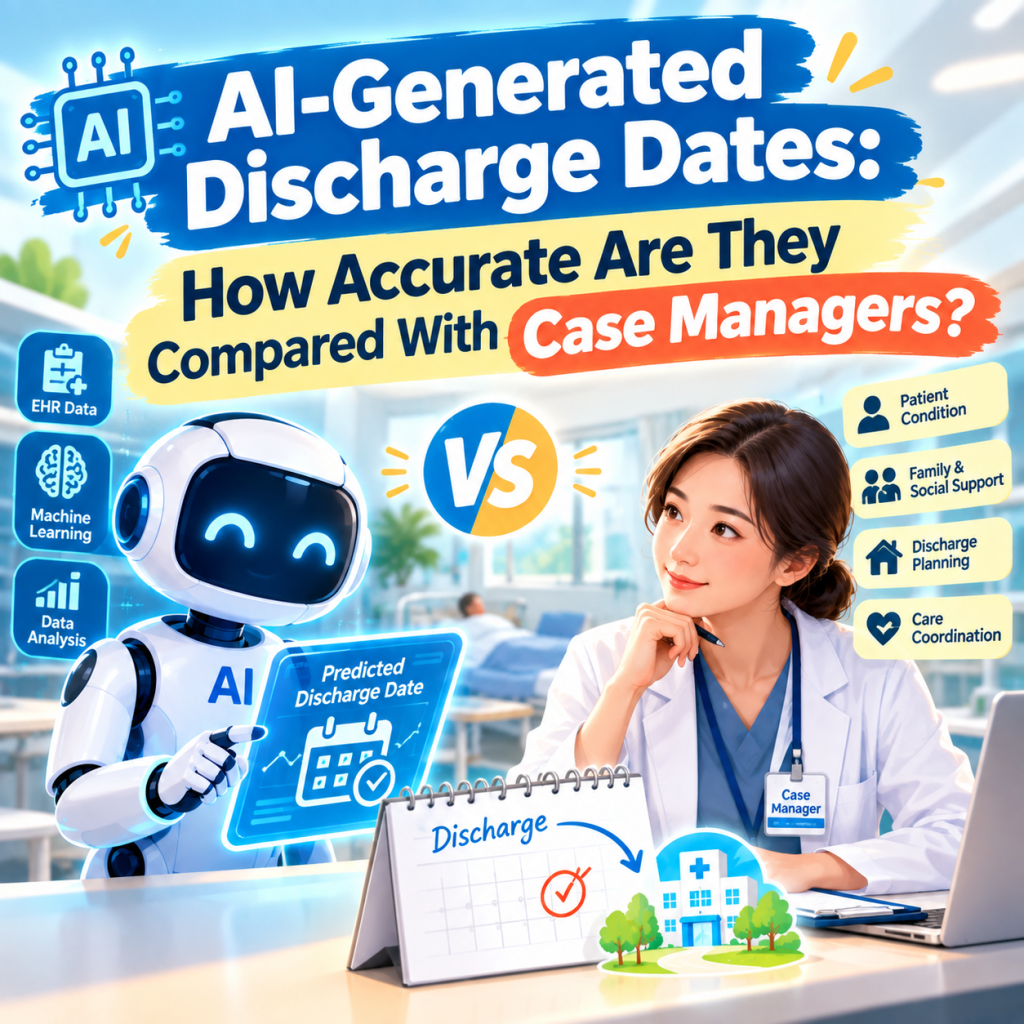
AI-Generated Discharge Dates: How Accurate Are They Compared With Case Managers?
Authors: Havish S. Kantheti, Connor Dolan, Jordan Dale
Journal: JAMA Network Open
Published: September 3, 2026
Part I. Study Overview
Background
Accurately predicting when hospitalized patients will be discharged can help hospitals optimize bed planning, patient flow, and post-discharge care coordination.
Machine-learning tools can use electronic health record (EHR) data to predict discharge dates, and commercial AI tools are increasingly being adopted in hospitals. However, most previous studies have compared AI predictions with patients’ actual discharge dates rather than with the case managers who are directly involved in discharge planning.
This study therefore compared:
*AI-predicted discharge dates
*Case manager–predicted discharge dates
*Actual discharge dates
at three stages of hospitalization: admission, approximately 48 hours before discharge, and approximately 24 hours before discharge.
Methods
This quality improvement study was conducted at Houston Methodist Hospital in the United States.
The study included 22,349 hospitalizations involving 17,173 patients, with discharge dates between August 1, 2023, and February 28, 2024.
A commercial AI clinical decision-support tool integrated with the EHR generated predicted discharge dates. Case managers independently documented their expected discharge dates as part of routine clinical practice.
Prediction accuracy was assessed using:
*Mean absolute error (MAE): the average difference, in days, between predicted and actual discharge dates. Lower values indicate greater accuracy.
*Mean difference: predicted date minus actual date. Negative values indicate earlier-than-actual predictions, whereas positive values indicate later-than-actual predictions.
Key Findings
1. At admission: AI and case managers performed similarly
| AI | Case Managers | |
|---|---|---|
| MAE | 4.20 days | 4.27 days |
| Within ±1 day | 40.8% | 46.3% |
| Exact prediction | 15.3% | 23.6% |
At admission, AI performed approximately as well as case managers overall. However, case managers were more likely to predict the exact discharge date or a date within ±1 day.
2. Approximately 48 hours before discharge: case managers became more accurate
| AI | Case Managers | |
|---|---|---|
| MAE | 1.59 days | 1.29 days |
| Within ±1 day | 41.7% | 63.6% |
| Exact prediction | 13.6% | 24.7% |
The advantage of case managers became increasingly apparent as discharge approached.
3. Approximately 24 hours before discharge: case managers clearly outperformed AI
| AI | Case Managers | |
|---|---|---|
| MAE | 1.93 days | 0.98 days |
| Within ±1 day | 37.9% | 79.5% |
| Exact prediction | 7.8% | 33.6% |
This was the most striking finding.
Nearly 80% of case manager predictions were within ±1 day of the actual discharge date, compared with only 37.9% of AI predictions.
4. AI prediction bias changed over time
At admission, the AI had a mean difference of −2.74 days, suggesting that it tended to predict discharge too early.
Approximately 24 hours before discharge, the mean difference became +1.24 days, indicating a tendency to predict discharge too late.
In contrast, case managers had a mean difference of only +0.04 days near discharge, indicating almost no systematic bias.
5. AI performance varied by length of stay and clinical setting
AI did not consistently perform worse than case managers.
For patients hospitalized for 1–2 days, MAE was:
*AI: 1.66 days
*Case managers: 0.89 days
For patients hospitalized for 5–7 days, AI actually performed better:
*AI: 1.49 days
*Case managers: 2.24 days
For hospitalizations lasting more than 14 days, both approaches performed relatively poorly.
Performance also varied across hospital units. Case managers were more accurate in obstetrics, whereas both AI and case managers performed poorly in the ICU.
Conclusion
AI performed similarly to current clinical practice when predicting discharge dates at admission. However, as patients approached actual discharge, case managers became substantially more accurate than AI.
The findings suggest that AI may provide useful early predictions but may not yet capture the real-time clinical and contextual information available to healthcare professionals near discharge.
Part II. PI-Union Medical Science Commentary
Can AI Really Replace Clinical Judgment?
The most important message of this study is not simply that humans performed better than AI. Rather, it raises a more important question:
Should we compare “AI vs. humans,” or should we develop better “AI + humans” systems?
Most AI studies evaluate whether an algorithm can predict an outcome accurately. This study goes one step further by comparing AI directly with the case managers who are actually involved in discharge planning.
This makes the research particularly relevant to real-world clinical practice.
1. AI has value for early prediction
At admission, AI and case managers had similar MAEs: 4.20 versus 4.27 days.
This suggests that AI can provide useful early estimates when the future clinical course remains highly uncertain.
For hospital operations, AI could potentially support:
*Bed planning
*Patient flow management
*Length-of-stay forecasting
*Resource allocation
*Post-discharge care planning
AI also has the advantage of continuously analyzing large amounts of EHR data and updating predictions.
2. But near discharge, human judgment becomes much more accurate
The most important finding is that case managers became increasingly accurate as discharge approached.
At approximately 24 hours before discharge:
Case manager MAE: 0.98 days
AI MAE: 1.93 days
And:
79.5% of case manager predictions were within ±1 day, compared with 37.9% for AI.
Why might this happen?
Clinical professionals may have access to information that is difficult for current AI systems to fully capture, such as:
*Current clinical status
*Treatment progress
*Physician decisions
*Family readiness
*Transportation and home-care arrangements
*Rehabilitation needs
*Medication preparation
*Social and caregiving circumstances
In other words:
More data do not necessarily mean better clinical judgment.
Clinical decision-making often requires integrating structured data with real-time, contextual, and social information.
3. AI is not simply “worse than humans”
The length-of-stay analysis provides an important nuance.
Among patients hospitalized for 5–7 days, AI actually had a lower MAE than case managers (1.49 vs 2.24 days).
This suggests that AI performance depends on:
Who, when, and where.
In future AI research, overall accuracy alone may therefore be insufficient. We should also ask:
- For whom does AI work best?
- At what point during hospitalization?
- In which clinical settings?
4. The future may be Human + AI
This study does not demonstrate that AI is ineffective.
Instead, it suggests that AI may be more valuable as a clinical augmentation tool rather than as a replacement for clinical judgment.
A future discharge management system could allow:
AI to:
*Continuously analyze EHR data
*Update discharge predictions
*Identify potential discharge delays
*Support bed management
*Flag high-risk cases
Clinical professionals to:
*Interpret real-time clinical status
*Integrate family and social circumstances
*Evaluate discharge readiness
*Address exceptions that AI cannot recognize
The goal would therefore be:
AI prediction + Clinical judgment = Better discharge planning
rather than:
AI replaces clinical judgment
5. The next question is not “Is AI accurate?” but “Does AI improve care?”
The study primarily evaluated prediction accuracy, not patient outcomes.
Future prospective studies should determine whether AI-supported discharge prediction can actually:
*Reduce length of stay
*Improve bed utilization
*Reduce avoidable discharge delays
*Improve transitions of care
*Reduce healthcare costs
*Decrease clinicians’ workload
*Improve patient outcomes
PI-Union Medical Science Take-Home Message
The key lesson from this study is:
AI can predict, but clinical professionals still need to judge.
AI performed reasonably well at admission, but case managers became substantially more accurate as patients approached discharge.
Therefore, the future of healthcare AI may not be:
Human vs. AI
but rather:
Human + AI
AI can process large amounts of data and generate continuous predictions, while clinical professionals contribute real-time judgment, contextual understanding, and patient-centered decision-making.
The most mature form of clinical AI may not be AI replacing clinicians, but AI and clinicians working together to make better decisions.
https://youtube.com/shorts/8W5XKqjL8iE
Reference: Artificial Intelligence–Generated Discharge Dates and Estimation Accuracy in Hospitalized Patients
Reviewer: PI-Union Medical Science Ltd.
* E-mail: piunion@pi-union.com
* Official Website: https://pi-union.com/
* Facebook: www.facebook.com/piunion2020
* Youtube: www.youtube.com/@pi-union
* Instagram: www.instagram.com/piunion2020
* LINE: @654eukag